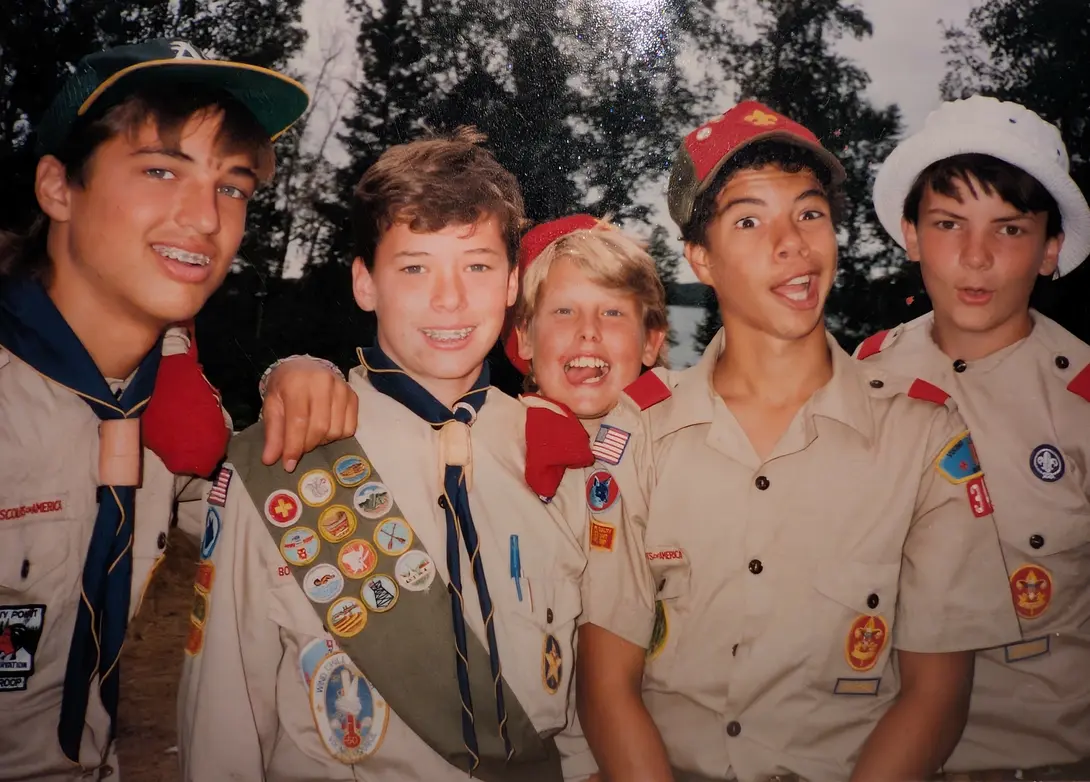
My daughter is off at grad school now, and she left a few tubs of her things in our basement. Over the weekend she came home to sort through them, and somehow the whole family ended up down there, each of us digging through our own boxes. I spent a couple hours on just one. I found a photo of myself in a Boy Scout uniform, and there on my chest was a badge that brings me joy: the Wind Chill Thriller.
In our Boy Scout troop we camped every single month, and I rarely missed a trip, all the way through middle school, junior high, and high school. The Wind Chill Thriller was usually earned by adding up cold nights over a season, but our troop was hardcore: you only got it if the wind chill actually hit fifty below while you were out camping. I earned it three times.
After seeing that photo, I woke up Monday morning thinking about how those winter camping trips resemble the life of a Buddhist monk. Stay with me.
Camping in the Snow and Cold
When the temperatures were really cold, especially in January, a winter campout only lasted one night. One of our favorite spots was the Charles L. Sommers Canoe Base near Ely, called Okpik. (The Wind Chill Thriller badge was phased out in 2001, but Okpik is still running.) We would do a significant amount of planning before we ever left, because honestly the goal was making sure nobody got frostbite or died.
We would leave before dawn and head North. When we arrived at a place like Okpik we strapped our gear onto pulks, little sleds that clip to your waist, and skied in with everything trailing behind us. We went until we found a good spot, and then we started piling snow. A lot of snow. Then we let it sit for at least three hours so the crystals could settle and bind. You cannot rush building a quinzee (not to be confused with an igloo).
While the snow set, we built a fire well away from the pile and melted pot after pot of it into water. Sometimes we made Russian tea, which in our troop meant tea mixed with orange Tang. I remember one trip where another scout and I filled a giant plastic Twins cup (from the Metrodome) with hot Tang and stood there facing each other, passing it back and forth, too cold to do anything but drink and hand it over.
When the three hours were up, we dug. Very carefully. Hollow out a quinzee the wrong way and you have no place to sleep, so we worked the inside out with small shovels and mittens (“choppers”) until it was big enough to hold all of us. Some had two rooms with a wall between them. By the time we finished there was just enough light left to cook dinner before crawling into the quinzee for bed.
A body gives off heat, and a quinzee full of bodies could climb to thirty degrees above zero while the air outside might be thirty degrees below, or colder. But the hardest part of the night often had nothing to do with the cold. It was deciding whether you could last until morning without going out to pee. Not everyone managed it. Pee by the door is gross. We’ll leave it there.
The second day was usually more chill (see what I did there?). We packed up, skied or walked back to the cars, and drove home. In all those years, as far as I know, nobody ever died.
Winter Camping and Monastic Life
Now those Boy Scout winter camping trips remind me of monastic life in ways I couldn’t have understood at age fifteen.
Sangha
Sangha is the community of practitioners. Out in the bitter cold, we relied on each other to stay alive. I can’t picture winter camping alone. It would just be too much work. Our warmer-month trips were different. Hiking, biking, or canoeing trips were about getting somewhere or doing something, and you could do them more or less on your own power. Winter was about survival, and survival is a group effort. A Buddhist monk depends on the generosity of laypeople for survival. As the Buddha said, “good friends, companions, and associates are the whole of the spiritual life.”
The Four Requisites
A monk needs four things to survive, and no more: food, clothing, shelter, and medicine. That’s the whole list. Tradition calls them the “four requisites,” and a monastic is meant to be content with a simple version of each.
Winter camping stripped life down to about the same four. We made simple food, because nobody wants to make a complex dish when the wind chill is fifty below. We wore the right clothing or we paid for it. We spent most of the daylight building shelter. We packed medicine in case someone got sick. There was nothing else to tend. No showers. Most of us didn’t change clothes the whole trip, and in the 80s and 90s there were no phones to check, no internet, and no photos to post. There was only the thing in front of us, which was usually the beautiful forest and a large pile of snow. Paying attention wasn’t just a technique we practiced, it was the only option the weather gave us.
We also didn’t have many goals. We weren’t trying to reach a summit or finish a route. The aim was to keep the quinzee from collapsing. A couple of times it did, and we were piling and hollowing snow late into the night, a little scared and tired. A monk isn’t chasing an outcome either. The practice is the point. You tend to the requisites, you keep the precepts, and you let the rest go.
The Code
Boy Scouts don’t have a monastic code, but the resemblance is hard to miss. Both come with a moral code the whole community is expected to live by: the Boy Scout Law and the five precepts, respectively. Boy Scouts say a blessing before meals. We treated the building of a shelter with reverence, because doing it sloppily had consequences. There’s a thread connecting “do it right because it matters” to the care a monk brings to the smallest parts of an ordinary day.
I’m not going to suggest that you need to sleep in a snowbank to deepen your practice. What has stayed with me from those weekends is how little we needed to be all right. Food, something warm to wear, a roof of packed snow, and medicine if it came to that. Everything past that was extra. Maybe sometime this week, when you catch yourself thinking you need one more thing to buy, check, or fix, you might pause and ask which of the four requisites it falls under: food, clothing, shelter, or medicine. If it’s none of them, notice how it feels to skip it.
Comments2
Winter camping
Hi Matt,
I loved reading about your winter camping experience with the Boyscouts, and the picture was priceless. What a wonderful experience for young people. There are so many lessons there, as you pointed out. The similarities with Buddhist Monks and the precepts, so beautifully put!
Thanks for this. Namaste,
Jen
Thank you, Jen!
Thank you, Jen! It's so nice to hear from you, and I really appreciate the feedback.