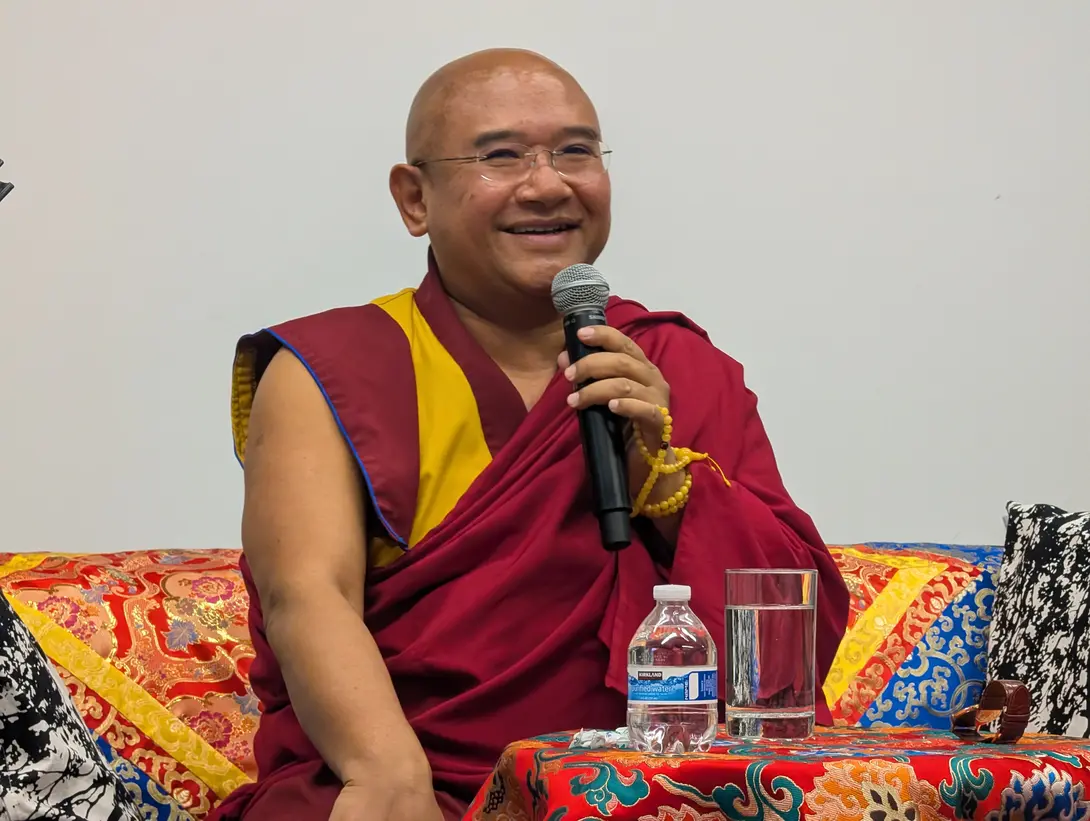
Last Thursday night, I asked a Tibetan monk if we should keep using the same practices in a world where the political climate feels unstable and AI threatens to change everything. He chuckled at the mention of AI, paused, and then said to use whatever tools work.
The talk by Venerable Geshe Lobsang Dawa, titled “A Guide to Transforming Adversity into Sustainable Peace,” happened at the Minneapolis Institute of Art. A friend who runs prison meditation groups around Minnesota had invited me. We got to the MIA early enough to check out the exhibits. The highlight for me was sitting (meditating) for a long time in the new Tibetan Buddhist Shrine Room, a small dim space full of sound (like this). Very meditative, and I highly recommend it.
For his talk, the Geshe sat on a small black couch draped in bright brocade, a glass of water on the table in front of him. He spoke in Tibetan in long stretches, maybe five minutes at a time, while a translator behind the podium took notes. Then the translator spoke in English (after the talk, I told the translator I was impressed by his abilities).
Much of what Venerable Geshe Lobsang Dawa said sounded like foundational Buddhist psychology, with some useful variations. He pointed out that most of us already have material happiness, yet we still suffer. So our work is with the mind, not with acquiring more or better possessions. Obvious in retrospect, but the way he laid it out showed why the real work happens with the mind. He also offered a metaphor I had not heard before: the mind is like water. Water can be heated or cooled. It can be affected by outside forces, and so can our moods.
At the end of his talk, the organizers opened it up to questions. He surprised everyone by answering the first question in English, after ninety minutes of speaking only in Tibetan. The question was about the difference between Mahayana and Theravada, and he handled it without trouble. His English was decent, but his accent made some parts difficult to understand.
When I had the opportunity, I asked about something directly related to his talk: practical advice on how to work toward “sustainable peace.” I said the world feels different than it did just a few decades ago, especially now that we have such an unstable political climate and AI. My question: should we use the same practices, or do we need to adapt?
He did not understand the question at first. He spoke for a while in English about his gratitude to the United States for supporting the people of Tibet. Someone in the audience clarified, in Tibetan. He nodded, and responded for a while in Tibetan. One line from the translator stood out to me: to train the mind, use any means or method available.
So simple: use what you have. It might be new or it might be 2,500 years old. The goal is training the mind, and the tool is whatever works.
This is not a new teaching. Patanjali says something similar in the Yoga Sutras. He lists a series of techniques for steadying the mind, and the final one (YS 1.39) gives a great deal of leeway: meditate on whatever supports steadiness and clarity for you. This is one of the many places where Buddhist practice and yoga overlap.
The Dalai Lama himself has spent decades treating science as a partner, and he famously said we may need to let go of beliefs that science proves wrong. So there I was, listening to a Geshe born near Boudhanath, trained in Dharamshala, telling a room in Minneapolis that AI does not change our assignment.
I personally resisted AI for a long time. After all, I spent decades building free software without it. Given the negative side effects of AI (data centers, pollution, tech bros trying to remake the world, exploited workers, etc.), I did not want to participate. But my mind was stretched to a new dimension at DrupalCon Chicago. I saw people working together to build free software with AI providers connected on the back end, and I realized the question was not whether to use AI but how. I saw how we could proceed without compromising our values.
When I got back from DrupalCon, I started taking my “AI budget” a bit more seriously, trying out more tools. It still felt icky, especially at first. But for some client work, I can now finish in an afternoon what used to take two weeks, and that’s hard to ignore. I have been exploring local models and models built and distributed more ethically. My practice changed because I let it change.
The Geshe’s answer is an invitation to bring everything you have. Use the breath practice you already know. Take a walk without your phone. Try something new that might only work for you. Trust the processes you have already built and add to them when something useful comes along.
This week, you might pick one method and use it on the part of your life that feels most affected by technology. It could be a practice you have done thousands of times or it could be something you have been meaning to try. Find out what works for you, use it until it no longer serves you, and then try again.
Comments2
AI and Leo's Encyclical: Keeping Humanity First
interesting note from the Geshe. I thought the Pope's latest encyclical which included a discussion on Artificial Intelligence was comprehensive and very well written. The AI section goes from 90-130, but i think i've linked the specific AI section below. We are in a buzzword world with limited attention span. If i can take one sentence, it might be this,
---- " If technological development advances without a corresponding ethical and social progress, the result may be an increase in means without a growth in humanity: “having more” without “being more.”
There is a lot more in the encyclical on AI (and many other topics!). It's worth a bit of time (~6K words) to chew through all he wrote and I'll likely come back to it.
thanks for sharing!
https://www.vatican.va/content/leo-xiv/en/encyclicals/documents/20260515-magnifica-humanitas.html#THE_GRANDEUR
Thanks, Jeremy! Yeah, I've…
Thanks, Jeremy! Yeah, I've been reading (and listening to an audio version of) the Pope's latest encyclical the past couple of days, and I agree that he has a lot of excellent ideas. I almost mentioned it in this post, but I felt like I wanted to finish it first.