One of the statements that I often say before savasana, near the end of a yoga class, is: “we’ve done meditation, breathing, postures, and now it’s time for relaxation.” I’ve said a similar version of that sentence for years, and it’s a reference not just to science, but also to four of the eight limbs of yoga:
- Yamas: social ethics
- Niyamas: personal observances
- Asana: yoga postures
- Pranayama: yogic breathing
- Pratyahara: sense withdrawal
- Dharana: concentration
- Dhyana: meditation
- Samadhi: absorption
People often encounter individual aspects of a yoga class that get renamed by specialists in other disciplines. A therapist might teach you mindfulness: dharana, concentration, renamed as Mindfulness-Based Stress Reduction (MBSR). A career coach might teach you a breathing technique before a big presentation: pranayama, but without the Sanskrit. A sleep app might walk you through something called iRest or Non-Sleep Deep Rest (NSDR): pratyahara, the withdrawal of the senses, repackaged for your phone. A physical therapist might give you three moves for your hips and call it “functional movement”: asana, the most well-known limb of yoga.
I am glad that people get access to these practices in a way that feels comfortable and safe. A therapist’s mindfulness training can help with stress. A sleep app’s NSDR session can improve sleep. I’d rather people have these tools than not. But each one is just a single limb, working alone, doing what it can without the other seven.
In a yoga class we don’t do just one limb, we aspire to do all eight.
The limbs of yoga are connected to modern yoga research, and Sat Bir Khalsa’s logic model is the most helpful visualization I’ve found for the physical practices:
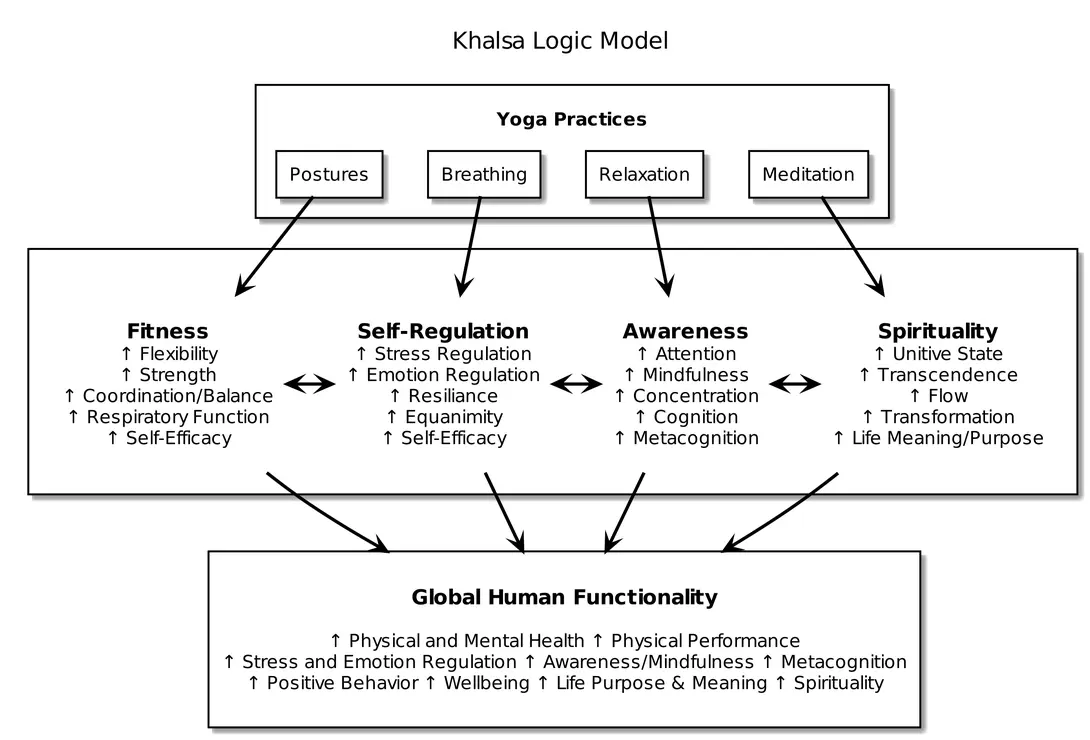
This model highlights the pieces of a modern yoga practice: postures, breathing, meditation, and relaxation. These feed into more generalized benefits, including improved cognitive and emotional functioning, less pain, and better sleep. Khalsa’s model traces how the whole practice engages these mechanisms together, something a single isolated technique doesn’t attempt to do.
That’s the science case for yoga. It’s a good case, but it only covers four limbs. The eight-limb path starts with yama and niyama, the ethical base of yoga, and it ends with samadhi, a settled wholeness that arises when the other limbs work together. Yoga ethics don’t usually feature on a sleep app or a therapist’s recommendations. I’ve written before about why that ethical piece deserves more attention than it usually gets, and I still think that’s true. A practice consisting only of breathing and postures is missing its foundation and its horizon. All of these limbs can help support a life of ease.
So whether you are on your mat or off it, and someone offers you a wellness technique, such as a breathing technique, a sleep protocol, a mindfulness practice, or something else that feels familiar, notice if it’s one of yoga’s limbs. Then consider how the other seven might support you. You don’t need four specialists and four appointments. One practice, outlined long ago by Patanjali, already does this.
Comments